Part 1: The Indispensable Foundation: Core Skills for Remote Success
Success in a remote environment requires a unique blend of technical proficiency and personal discipline. While hard skills get your foot in the door, it's often the soft skills that determine your long-term growth and effectiveness.
The Soft Skills That Make Employers Trust You
A striking study found that 85% of professional success can be attributed to well-developed soft skills. In a remote setting, where managers can't observe you directly, demonstrating these traits is critical.
Clear & Proactive Communication: This is the #1 most critical skill. It means articulating ideas clearly across email, chat, and video calls, providing regular updates without being asked, and over-communicating to compensate for the lack of physical presence. Ambiguity is the enemy of remote teams.
Self-Management & Discipline: Remote work grants freedom, which requires responsibility. You must be adept at managing your own time, setting priorities, avoiding distractions, and meeting deadlines without supervision. This includes establishing a dedicated workspace and a firm routine to separate "work" from "home."
Problem-Solving & Initiative: When a challenge arises, you can't immediately turn to the person at the next desk. Employers value remote workers who can think critically, research solutions independently, and propose actionable fixes before escalating an issue.
Digital Collaboration & Etiquette: Thriving in a remote team means mastering digital tools (like Slack, Teams, or Asana) and understanding virtual etiquette—knowing when to send a message vs. schedule a call, respecting time zones, and contributing effectively to virtual meetings.
The Hard Skills That Get You the Interview
These are the teachable, measurable abilities that you can list on your resume and demonstrate in a portfolio. The most in-demand hard skills are those that can be performed digitally from anywhere. The table below compares several foundational and high-growth skill paths to help you identify a potential starting point.
Part 2: Deep Dive into High-Demand Remote Careers and Training Paths
Let's explore specific, lucrative career paths you can train for online, along with concrete steps to get started.
1. The Digital Marketer & E-commerce Specialist
With businesses thriving online, expertise in attracting and converting digital customers is golden. The U.S. Bureau of Labor Statistics projects an 8% growth in hiring for these roles.
Career Pathway: Start as a Social Media Coordinator or SEO Assistant, advance to Digital Marketing Manager, and potentially become a Director of E-commerce.
Skills to Learn: Search Engine Optimization (SEO), content marketing, pay-per-click (PPC) advertising, email marketing, data analytics, and platform-specific skills for Shopify or Amazon.
Top Training Pick: The Google Digital Marketing & E-commerce Professional Certificate on Coursera. It's designed by Google, takes about 6 months, and includes hands-on projects using real-world tools.
2. The Data Analyst
In our data-driven world, professionals who can transform numbers into insights are invaluable. This field offers a perfect blend of high demand and remote compatibility.
Career Pathway: Begin as a Data Entry Clerk or Junior Analyst, progress to Data Analyst, and specialize into roles like Data Scientist or Business Intelligence Analyst.
Skills to Learn: Statistical analysis, data visualization, proficiency in SQL for database querying, and tools like Python, R, or Tableau.
Top Training Pick: The Google Data Analytics Professional Certificate. This program guides you through the entire data analysis process and uses case studies to build a portfolio-ready project.
3. The Cybersecurity Professional
As cyber threats grow, so does the talent shortage. Hiring for Information Security Analysts is projected to surge by 33%, and about 70% of professionals in this field already work remotely.
Career Pathway: Enter through IT Support, move into a Cybersecurity Analyst role, and advance to specialist positions like Security Architect or Penetration Tester.
Skills to Learn: Network security, threat analysis, incident response, compliance standards, and tools for encryption and intrusion detection.
Top Training Pick: The Google Cybersecurity Professional Certificate. It provides a comprehensive foundation in Python, Linux, security models, and incident response without requiring a prior degree.
4. The UX/UI Designer
This field merges creativity with psychology and technology to create products people love to use. It's consistently ranked among the most satisfying and well-compensated tech careers.
Career Pathway: Start as a Visual Designer or UX Researcher, become a UX/UI Designer, and grow into a Lead Product Designer or Design Manager.
Skills to Learn: User research, wireframing, prototyping, interaction design, and usability testing. Proficiency in design tools is a must.
Top Training Pick: The Google UX Design Professional Certificate. It's a project-based program where you complete three end-to-end projects for a professional portfolio.
Part 3: Navigating Your Training Options: From Free Courses to Online Degrees
The beauty of modern education is the spectrum of options available. You can choose a path that fits your budget, timeline, and career goals.
Free and Low-Cost Skill Bootcamps
Ideal for quickly gaining marketable skills or exploring a new field.
Platforms like SkillCareer, freeCodeCamp, and Alison offer free courses in coding, design, and business skills.
Semrush Academy and HubSpot Academy provide excellent free certifications in SEO, content marketing, and inbound sales.
The Google Career Certificates (Data, UX, Project Management, etc.) operate on a subscription model (around $49/month) but can be completed in 3-6 months, offering exceptional value for a credential from a top employer.
Comprehensive Online Degrees
For those seeking a deep, formal education and credentials for leadership roles or career changes.
Bachelor's Degrees: Fully online degrees in Information Technology, Business, Marketing, Accounting, or Communication are powerful foundations for remote careers. They typically take 3-4 years but offer the most comprehensive credential.
Master's Degrees: Online Master of Science (MSc) programs in fields like Data Science, Artificial Intelligence, or Cybersecurity (like those from Brunel University of London on FutureLearn) can accelerate your career into high-paying, specialized remote roles.
Credit for Certificates: Some universities, like Purdue University Global, offer college credit for completing professional certificates (like Google's), bridging the gap between short-term training and a degree.
To help you decide, the table below outlines the key differences between these training approaches.
Part 4: Launching Your Remote Career: From Training to Employment
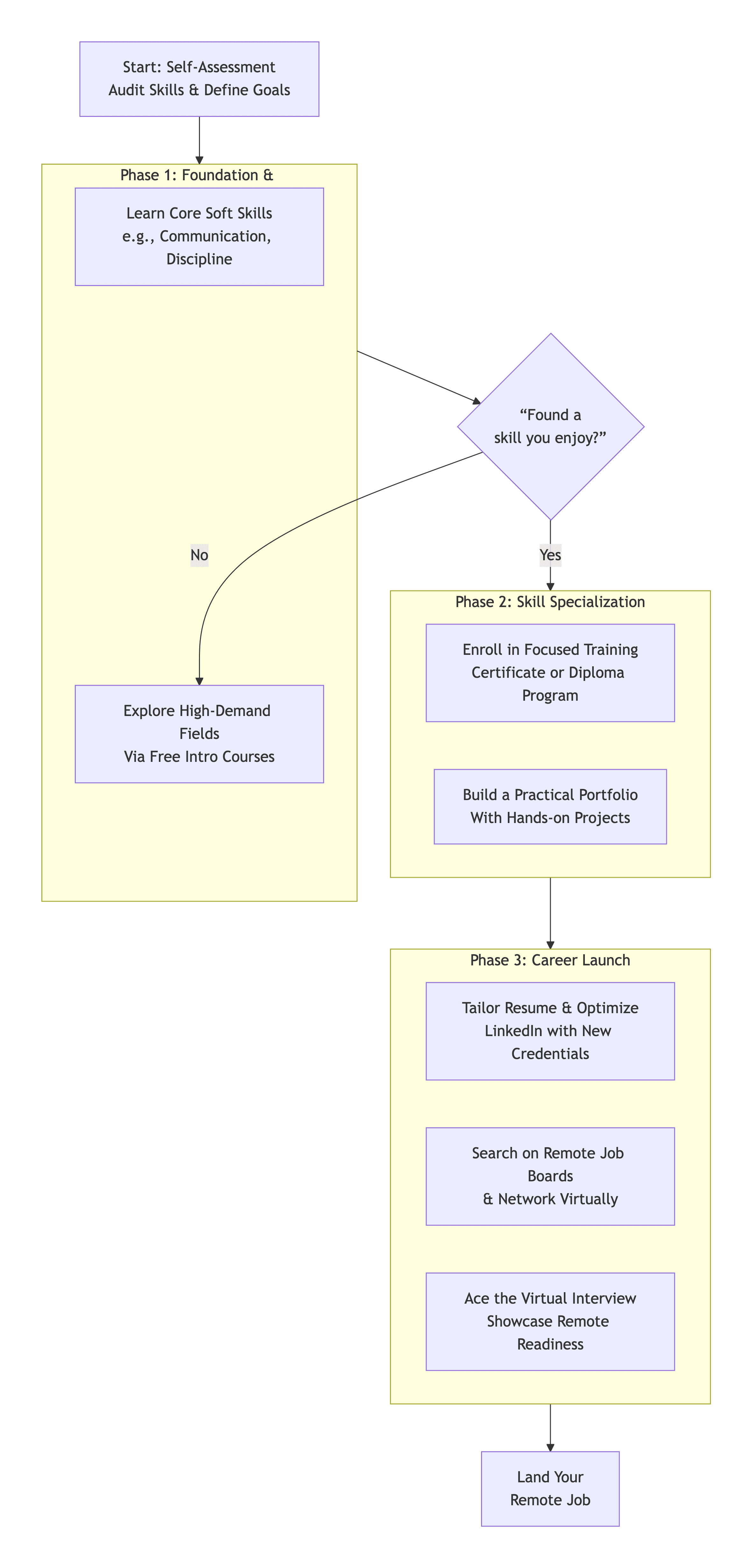
Completing your training is a major milestone, but the job search is the next critical phase. Here’s how to bridge the gap.
1. Build a Proof-of-Work Portfolio
In a remote hiring process, your portfolio is your most powerful asset.
For Designers/Marketers: Showcase live websites, campaign reports, or design case studies.
For Data Analysts/Programmers: Create a GitHub profile with code samples or a blog post analyzing a public dataset.
For Project Managers: Detail projects you've managed (even volunteer work), including tools used, challenges overcome, and outcomes achieved.
2. Tailor Your Application for Remote Work
Resume: Highlight remote-friendly skills like "self-directed," "asynchronous communication," and "proficient in [remote tools like Slack, Asana]." List your online certifications prominently.
LinkedIn Profile: Use the headline "Aspiring Remote [Job Title]." In your summary, explicitly state your desire for remote work and your readiness for a distributed team environment.
Cover Letter: Don't just say you want to work from home. Explain why you excel at it by giving examples of your discipline, communication skills, and time management.
3. Find and Apply for the Right Jobs
Use Specialized Job Boards: Go beyond Indeed and LinkedIn. Use sites like FlexJobs (which vets its listings for scams), Remote.co, and We Work Remotely.
Network in Virtual Spaces: Join industry-specific Slack groups, participate in Twitter chats, and attend virtual webinars. Let your network know you're seeking remote opportunities.
Prepare for the Virtual Interview: Test your technology beforehand. Have examples ready that demonstrate your remote work competencies. Prepare thoughtful questions about the company's remote culture and communication practices.
Conclusion: Your Future, Unlocked
The dream of a fulfilling, flexible career is not reserved for a lucky few. It is a tangible goal within your reach. The remote work revolution has democratized opportunity, placing the emphasis squarely on skills, initiative, and the ability to learn.
Your journey starts with a single, deliberate step: choosing one skill that aligns with your interests and the market's needs and committing to learn it. Whether through a free introductory course or a dedicated certificate program, every module completed brings you closer to a new reality.
The tools, the training, and the jobs are all available online. The only missing ingredient is you. Start building your future today—one skill at a time.
Ready to begin? Explore the free course catalogs on platforms like Coursera, edX, or SkillCareer to take your first step. Your remote career awaits.